
You Know What’s Really Scary? How Normalized Our Suffering Has Become
The real fear isn’t monsters — it’s how society treats the sick and disabled.

Content Note: This piece discusses disability, chronic illness, systemic ableism, medical neglect, and the normalization of suffering.
You know what’s really scary?
How many disabled people disappear when they stop being “inspirational.”
It’s not a surprise, our culture loves “overcoming” stories. It’s on the nightly news. It’s in that viral video. It warms our hearts to know that the disabled folks are still happy, still finding their way to be a cog in the capitalist system. It brings us to tears to think, if that happens to me, I can overcome it and find joy and success.
But in doing so, we close our eyes to grief, ongoing illness, and dependence.
The true horror is vanishing from public empathy when you’re no longer marketable.
Disability is not a monolith.
Our experiences are complex, joyful, messy, worthy, dark, beautiful, and always changing.
Our experiences don’t need to be transcended to be worthy of admiration.
Our experiences don’t have to make able-bodied people comfortable.
The truth is, there’s nothing to overcome.
We are not at war with our bodies. This is not a battleground.
To accept our illness and find the peace within the suffering is not to give up.
It’s to become whole again.
And when we stop applauding the “fighters,” we stop asking why we’re all expected to fight in the first place.
The glorification of resilience is how the system hides the harm it causes, and how it absolves itself of care.
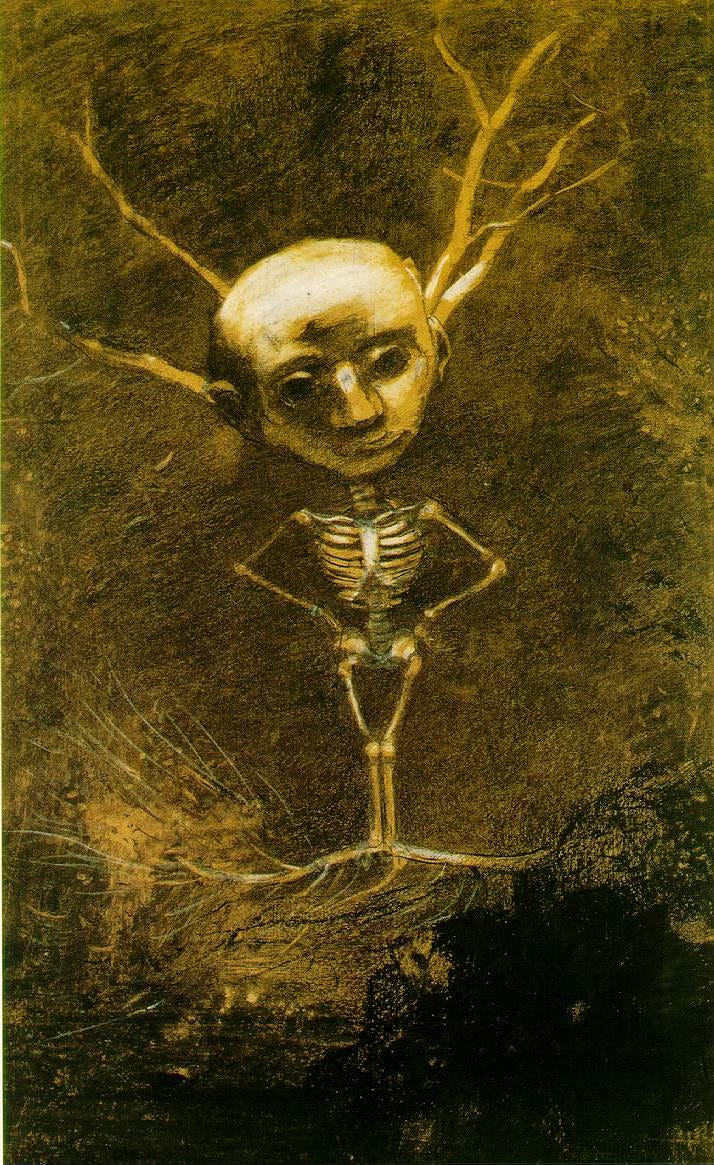
You know what’s really scary?
How easily we normalize suffering—and how many of us live in bodies that medicine still doesn’t understand.
We burn ourselves out in these capitalist systems. And then doctor after doctor gaslights us.
The monsters aren’t in horror movies. They’re in healthcare.
This is the ghostly experience of living with something “invisible” that’s also very real.
A haunting. A pain that is ignored but ever-present.
I’ve learned to mask my pain like background noise.
I stop mentioning it because I know they’ll call it anxiety.
I start to wonder if I’m the ghost.
But people only want to put money towards illnesses they can cure.
Because to cure is to slot us right back into extraction, right back into the systems that wound us.
They like the illnesses that have an easy story arc from sick to healed. Ones with a heroic end. Not the ones that live liminally. It’s why things like hEDS, POTS, long covid, and fibromyalgia are so sorely underresearched. These are the illnesses that never resolve, that live in the hallway between “sick enough to matter” and “well enough to work.”
You know what’s really scary?
How afraid we are of needing each other.
We’ve internalized the same logic that harms us.
The system teaches us to be self-sufficient, even as it depends on our exhaustion.
Ableism thrives on the illusion of autonomy. We’re fractured. Communities are dismantled. We’re taught that needing each other is shameful, that support must be earned or bought.
Accessibility is treated like a luxury, and interdependence like a weakness.
All so that we turn to capitalism as if it can support us.
As if we can buy something to fix us.
As if we don’t just need each other.
You know what’s really scary?
Disabled people know the end of the world better than anyone.
We’ve lived through medical collapse, housing collapse, social collapse. The quiet apocalypses that happen one denied claim at a time.
To become disabled is to peek behind the curtain.
To see how the systems fail us.
To see how little regard the ones in charge have for us.
To see how scared the able-bodied are. How they look away and pretend we don’t exist. How their fear is weaponized in anger.
To see how eugenics is alive and well.
It’s in the general disregard for something as small as wearing a mask.
It’s in the genetic testing designed to “prevent suffering,” but also to prevent the existence of disabled people.
It’s in the surveillance to prove we’re disabled enough to be worthy of resources.
It’s in the obsession with output and efficiency, hierarchies of value that tell us if we can’t work, we are a burden.
We’ve already learned how to live through collapse.
Disabled people are some of the most creative people I’ve met.
We know how to live alongside the ghosts, and the monsters. They’re inside of us all.
We know how to bring light and beauty into our haunted corners.
We know how to find each other’s hands in the darkness.
Maybe the scariest thing of all is that the world still refuses to listen.
Previous pieces I’ve written from the darkness:


This made me cry, Vöx. We are fed the myths of “battling” illnesses, read stories of heroes like Deborah James who dedicated what was left of her life to raising awareness of bowel cancer, of resilience and of overcoming adversity. So when our bodies stop working like they used to we become invisible, told we are of no value and don’t deserve help, because we are “economically inactive” - ie not supporting the capitalist system by working within it. It is a miserable situation and I am living it right now. I would love to upgrade to paid to support you, but I had my disability benefits stopped in August and I am up to my eyes in debt.
Sending love and gentle hugs ❤️
The ending to this piece really resonated with me (well, the whole piece did but particularly the end). I’ve been reflecting on the ways living in a body that struggles heavily within current social structures has forced me into learning skills that are necessary for the precarious times we live in, yet I find that any mention of my disability, particularly with folks who do not see disability as a nuanced experience and hold a lot of fear/shame around disability, triggers either complete avoidance, or a positivity washed take. I appreciate this piece as a reminder that our disabled knowledge is very needed.